A learning outcome may be defined as a specific written statement of what the successful student is expected to be able to do in a measurable way at the end of the module or course unit, or qualification. Learning outcomes generally include action verbs to describe what students should be able to do, such as identify, apply, analyse, evaluate. For instance, a learning outcome in a medical context might be: ‘the ability to describe qualitatively the relationships between risk factors and acute respiratory infections using data from published sources’
A competence standard may be defined as a more general statement of the required knowledge, skills and behaviour of a student completing a module, course unit or qualification. Being competent means having the ability to apply the skills and knowledge needed to perform in a particular educational or professional role. Examples of competence standards include:
- Demonstrating appropriate personal and professional values and behaviours (General Medical Council)
- Effectively managing and delivering a project from inception to project completion (Architects Registration Board)
All courses should have learning outcomes but not all courses will involve competence standards.
Competence standards are often associated with the performance of specialist roles and particularly those connected to regulated professions such as medicine, law and architecture.
Competence standards, unlike learning outcomes, are defined in the Equality Act:
‘An academic, medical or other standard applied for the purposes of determining whether or not a person has a particular level of competence or ability.’ (Schedule 13, paragraph 4(3))
The legal significance of this definition is that competence standards are not Policies, Criteria or Practices (PCPs) and are therefore exempt from the duty to make reasonable adjustments for those with disabilities. Learning outcomes are PCPs and are subject to the duty to make reasonable adjustments.
Competence standards apply equally to all students (including disabled students) because they represent what is necessary to determine if a student has reached a required level of demonstrable ability that they can perform consistently within a specified context.
Gauging what is required to meet a particular standard of ability can be done in several ways. For example, it could be through an approach that is binary (i.e. a pass/fail threshold) or modal (i.e. a standard that the typical student is expected to achieve).
Where a competence standard is used to determine if an individual can be awarded professional status a binary approach is often deemed appropriate.
However, it is also possible to meet an overall competence standard without passing or even completing every element of a course.
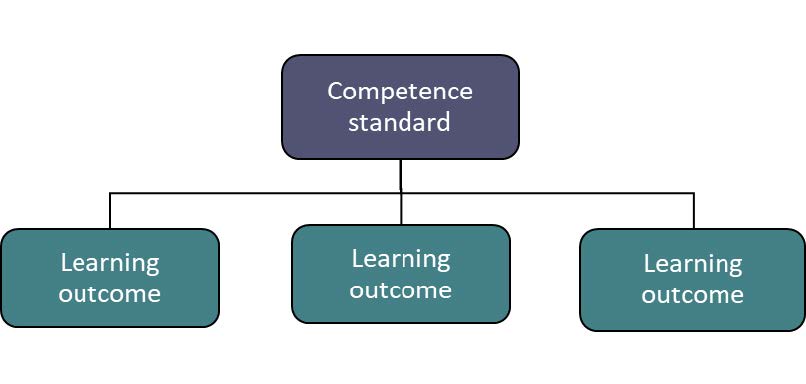
Applying competence standards requires a way to gauge what is required. As competence standards are generally broad, learning outcomes may be used to describe more specifically what is required. Several learning outcomes may be needed to explain how a competence standard can be reached. Learning outcomes must be articulated inclusively, and should apply to as many students as possible, but they are subject to the duty to make reasonable adjustments, which means that you should adapt them to an individual disabled student in any way which still enables that student to meet the overarching competence standard.