
Professional and Statutory Regulatory Bodies (PSRBs) play a vital role in our higher education system. As the world of work rapidly evolves, effective partnerships between higher education providers and PSRBs are essential to preparing graduates for successful careers and lifelong learning.
This project, developed in collaboration with London South Bank University (LSBU) explores how to enhance these relationships to benefit students, institutions, and industries.
It forms part of the Designing Education for the Future Advance HE member benefit 2024-25.
Understanding PSRBs
The role and powers of PSRBs vary across countries, sectors and professions. Some have legislative authority to protect public interest, while others act in an advisory capacity. For certain professions, PSRB membership is mandatory, with powers to assess both curriculum quality and practitioner fitness.
Higher education institutions must work closely with PSRBs to ensure qualifications enable graduates to enter and succeed in their chosen professions. While these partnerships offer numerous benefits, they also present challenges related to pedagogy, accessibility, and innovation.
The benefits and challenges
Benefits
- Enhanced credibility: PSRB recognition provides external quality assurance, supporting graduate employability and institutional reputation.
- Improved employability: Graduates from PSRB-recognised courses often have better job opportunities and faster paths to professional status.
- Curriculum relevance: PSRB recognition helps universities benchmark courses against industry standards and professional expectations.
- Quality assurance: PSRBs ensure graduates have achieved the necessary professional competencies for their chosen field.
Challenges
- Perceived rigidity: While necessary for public confidence, rigid standards can unfairly penalise students through their interpretation.
- Resource requirements: Managing relationships with diverse PSRBs with varying requirements can be resource-intensive.
- Inclusivity gap: Some PSRB standards don’t fully address the needs of students with disabilities or from diverse backgrounds.
- Bureaucratic hurdles: Requirements for curriculum modifications can hinder responsiveness to changing industry needs.
Our Project Goals
At Advance HE and LSBU, we are exploring how to better understand sector-wide practices and identify opportunities for improving existing partnerships. Through the lens of “Designing Education for the Future,” we aim to ensure that PSRB partnerships support the development of capable, future-ready graduates.
We aim to:
- Help institutions strengthen and make more effective relationships with PSRBs to support high-quality outcomes for students and the public.
- Identify best practices in institutional relationships with PSRBs and, where possible, standardise and streamline processes to reduce administrative and regulatory burden.
- Showcase how PSRBs support innovation in higher education and help institutions adapt to changing professional requirements and workplace demands.
- Increase collaboration between higher education and PSRBs to promote pedagogic innovation and improve inclusivity and flexibility in course design, delivery, and assessment.
Introducing the project
As we consider how to design Education for the Future, in this blog, Professor Deborah Johnston (MBE), Deputy Vice-Chancellor (Academic Framework), London South Bank University argues that universities and PSRBs need to collaborate closely to respond to the changing needs of students and employers.
Outputs
Bridging the gap: the strategic value of enhanced PSRB-university partnerships in higher education
On 5 December 2024, Advance HE and LSBU co-hosted a networking event for colleagues from higher education providers and PSRBs. The event focused on addressing the evolving needs of students and employers to enable them to thrive in the future world of work. In this blog, we reflect on the challenges and opportunities discussed, and outlines the next steps for fostering enhanced partnerships.

Case studies
These case studies explore the evolution and innovation of professional accreditation processes across different disciplines. Together, these cases highlight the ongoing tension between maintaining professional standards and reducing administrative burden, while illustrating how accreditation bodies must adapt to remain relevant in rapidly evolving fields, ultimately benefiting students, institutions, and industries alike.
Accrediting Innovation – How disruptors meet standards
This case study examines the experiences of Kay Bond, Academic Head at the Dyson Institute of Engineering, and her involvement with three emerging engineering education providers in the UK: the Dyson Institute, TEDI London, and NMITE (New Model Institute for Technology and Engineering).
Developing a National Framework to Embed the NMC Standards for Student Supervision and Assessment across Nursing and Midwifery
Priti Patel, Head of Division for Midwifery and Lead Midwife for Education at London South University, presents a case study on collaborative work between Professional Statutory and Regulatory Bodies (PSRBs), Higher Education Institutions (HEIs), and practice partners to improve student experiences in healthcare education.
Evolution of Accreditation from a PSRB and an HEI perspective
This case study follows Professor Alistair Irons’ journey with the British Computer Society (BCS) accreditation process over approximately 20 years. From his early experiences as a programme lead managing accreditation at his institution to becoming Chair of the Academic Board and Vice President, the narrative illustrates the evolution of accreditation practices in computer science education in the UK.
‘One Man, Two Guvnors’: Leading accessible and engaging accredited provision: A Guide for programme leaders
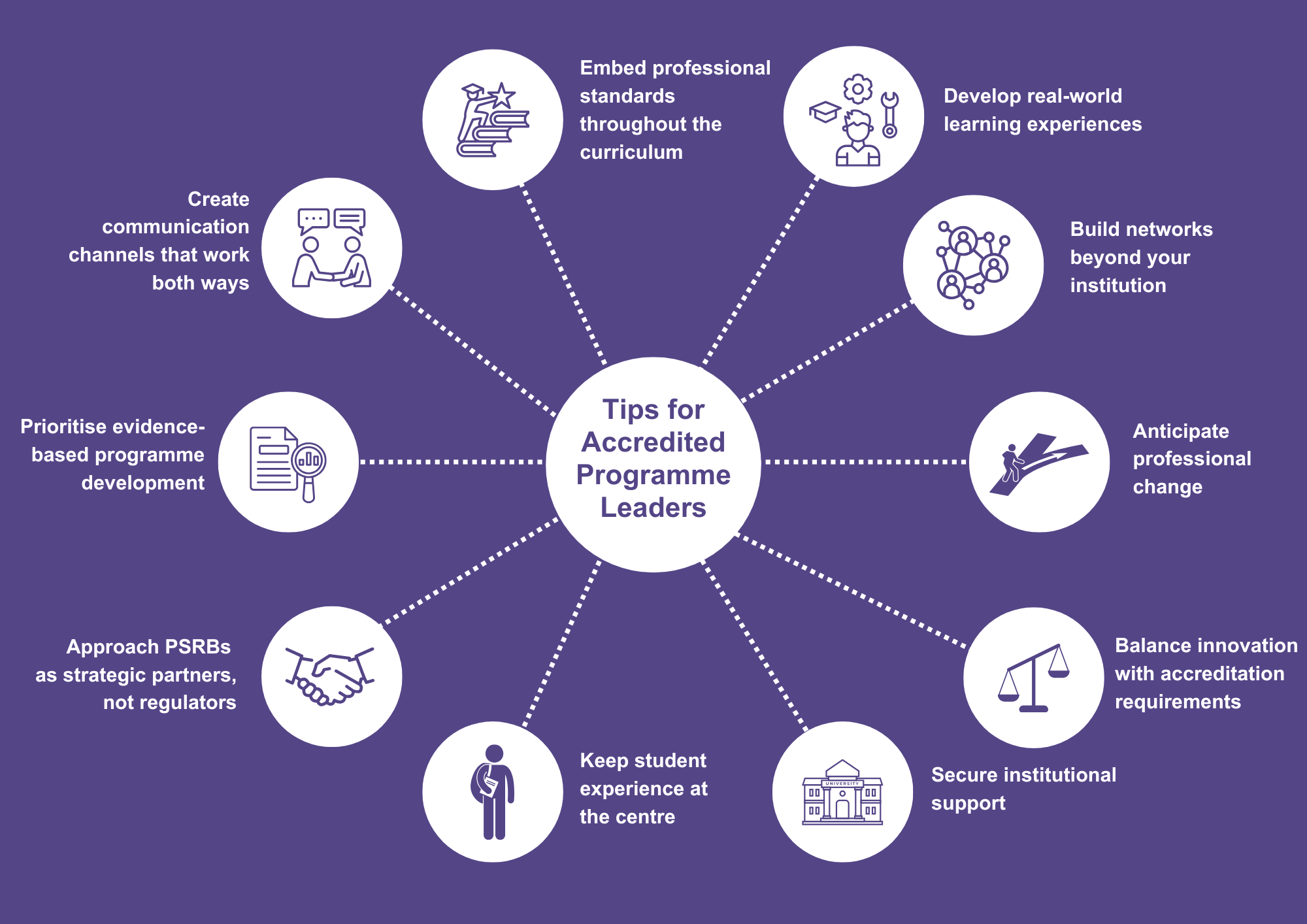
Leaders of accredited programmes face a unique challenge: “We’re not just designing curricula; we’re building professional pathways that must simultaneously satisfy academic rigour and professional standards. “
The top tips for programme leaders were compiled from discussion at the recent networking event for colleagues from higher education providers and PSRBs co-hosted by Advance HE and LSBU. They emphasise the partnership approach needed to work effectively with PSRBs, evidence-based programme development, and finding the balance between innovation and compliance. They also highlight the importance of networking, anticipating professional changes, and keeping student experience central to all decisions.

Published On: 09/04/2025
‘One Man, Two Guvnors’: Leading accessible and engaging accredited provision: A Guide for Programme Leaders
Leaders of accredited programmes face a unique challenge: “We're not just designing curricula; we're building professional pathways that must simultaneously satisfy academic rigour and professional standards. “ The top tips for programme leaders were compiled from discussion at the recent networking event for colleagues from higher education providers and PSRBs co-hosted by Advance HE and LSBU.
Webinar: Top tips for programme leaders to build new partnerships with PSRBs
27 May 2025, 12:00 – 13:00 (BST), 11:00 – 12:00 (UTC)
Exclusively for colleagues that work at Advance HE member institutions, this webinar brings together experienced leaders and innovators to discuss the evolving landscape of accredited programmes across different disciplines and provides top tips for programme leaders in developing and utilising their relationships with PSRBs for student and institutional success.
