

Student support services are essential to student success, but UK higher education lacks a shared framework for assessing them.
The Enhancing Student Support: Benchmarking Effectiveness and Efficiency feeds directly into the UUK Transformation and Efficiency Taskforce. The member benefit will provide a topography and benchmark for how student support services are organised, delivered and resourced across UK higher education.
The member benefit aims to develop a consistent evidence base and shared framework that can be considered and adopted by all HE providers after the initial project, proving a tool for comparison and discussion.
Working collaboratively with support from partners, the Advance HE project will develop a shared map for describing student support, undertake sector-wide mapping and analysis, identify service model typologies and high-impact design patterns and produce practical benchmarking for providers.
Interested in participating in this project?
We’re inviting UK Advance HE members to register their interest in participating in this project.
Registering your interest doesn’t guarantee participation, but we will be in touch with interested institutions with more information about the project and next steps.
Student support services play a significant role in student success. This cross-sector project will build a clearer understanding of how higher education institutions can deliver that student support most effectively by benchmarking practice across services, sharing evidence and learning from each other. It will identify opportunities to strengthen the impact of student support services to enhance outcomes for graduates
Alistair Jarvis CBE, Chief Executive, Advance HE

What will the project deliver?
The initiative will produce:
- A shared framework for categorising student support services
- Anonymised benchmark data across the breadth of the survey, enabling institutions to understand sector trends and approaches
- Insights into digital maturity and AI adoption
- Student support service model typologies
- Examples of effective practice and approaches that have delivered positive outcomes
- A sector synthesis report for executive leaders and governing bodies
- A publicly available case study compendium
Institutions will benefit from:
- Structured reflection and planning resources
- Practical examples of effective and efficient student support delivery
- Opportunities to contribute to the development of future sector tools
This is a non-competitive, improvement-focused initiative. There will be no league tables or institutional rankings. Instead, the project focuses on benchmark ranges, typologies and practical evidence that support informed decision-making and continuous improvement.
Who is it relevant for:
- Directors of Student Services
- Pro Vice-Chancellors (Student Experience)
- Pro Vice-Chancellors (Education)
- Chief Operating Officers
- Planning, Registry and Professional Services leaders
- Institutional teams responsible for student success, wellbeing and support
Project Advisers Include

Jisc

Mental Wellbeing in Higher Education (MWBHE)
AMOSSHE

Guild HE
At a time when institutions are facing increasing demands on their resources, it is particularly important that we understand what works well, where there are opportunities to do things differently, and how our approaches compare with those of our peers. By bringing together sector data, benchmarking and institutional experience, this work will help members identify opportunities to improve and make informed decisions about where their resources can have the greatest impact on student success.”
Stuart Norton, Head of Educational Excellence, Advance HE
Project Team

Stuart Norton, PFHEA
Head of Educational Excellence, Advance HE
Stuart has over 20 years’ experience within higher education with extensive experience in designing and developing strategic, institutional-wide change. In his role as Head of Educational Excellence at Advance HE, he focuses on both thought leadership and providing evidence-based solutions to support institutions, educators and students.

Jonathan Neves
Head of Business Intelligence & Surveys, Advance HE
Jonathan joined Advance HE in 2015, bringing with him 16 years’ experience in customer insight and market research. Jonathan began his career with TNS in London and has worked for market research agencies Quaestor and Optimisa, and also client-side at The Co-op, before specialising in Education. Jonathan graduated from the University of Liverpool with a degree in Geography, and is a full member of the Market Research Society.

Emma Boerjes
Researcher, Advance HE
Emma expertise in survey design and quantitative analysis, alongside qualitative methods including interviews and focus groups. She also has experience delivering workshops and training on evaluation methods, and producing research and evaluation reports for sector stakeholders and academic audiences. At Advance HE, she leads mixed-methods research and evaluation projects across the higher education sector.

Professor Kate Strudwick
Lead Associate
Kate Strudwick is Professor of Student Engagement and Dean of Teaching and Learning at the University of Lincoln. As Head of Department for the Centre for Education and Students (CES), Kate has sustained academic leadership experience enhancing student experience, embedding employability and Sense of Belonging, and has demonstrated sustained positive contributions to the advancement of the University of Lincoln’s educational offer and strategic priorities.
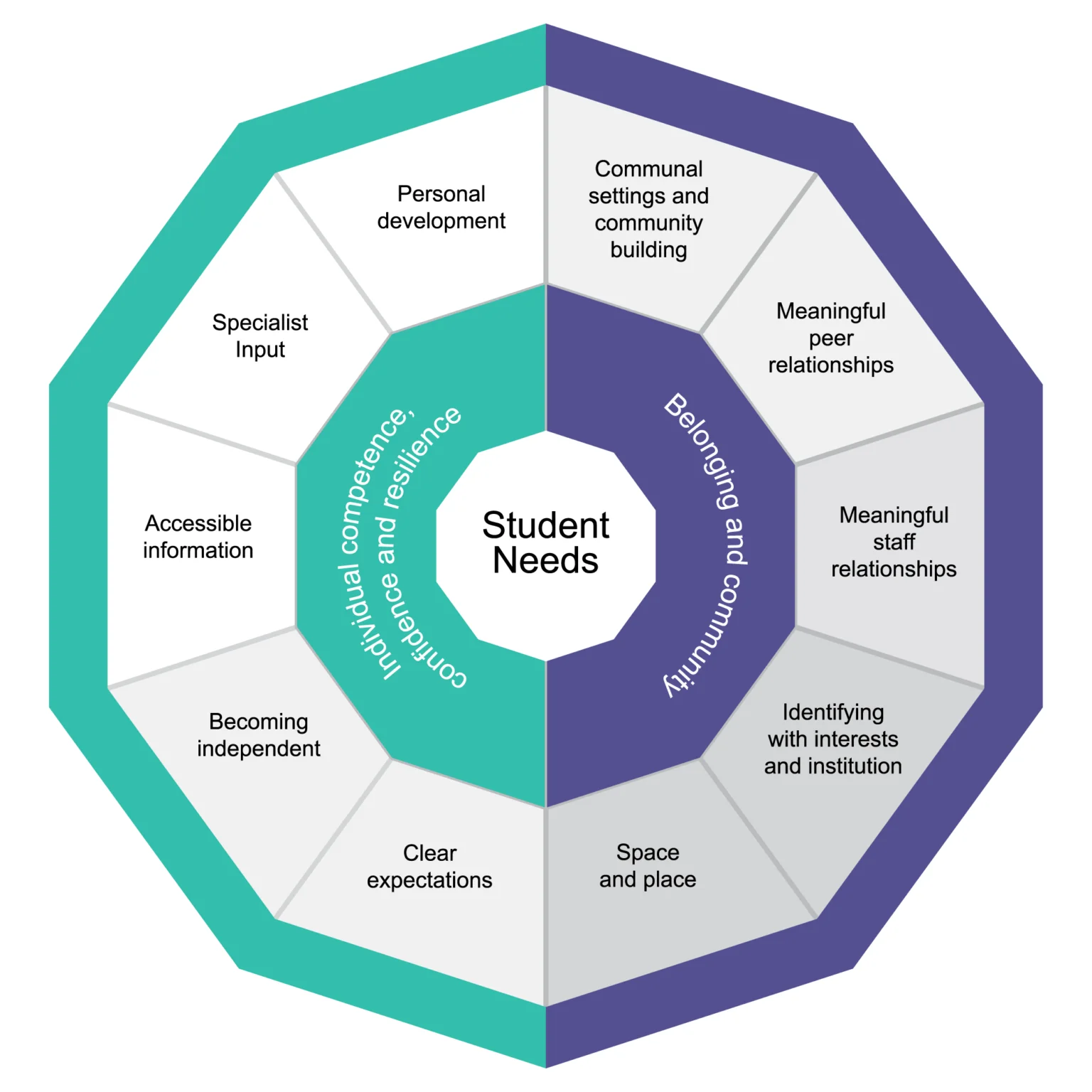
Student Needs Framework
The Student Needs Framework describes the fundamental needs of students. It provides a tool for higher education providers to consider how their current student support offer meets these needs, where there are gaps, overlaps and where better institutional connections are needed.
The Higher Education Student Support Champion working in partnership with the UUK Student Policy Network and Advance HE has designed a framework which provides a starting point for institutional conversations about re-designing student support and supports the mapping of current and future provision in regards to meeting student needs.
The Framework is designed to enable sector-wide dialogue and collaboration, encourage sharing of emerging and established good practice, and facilitate understanding of what works when delivering systematic change.
