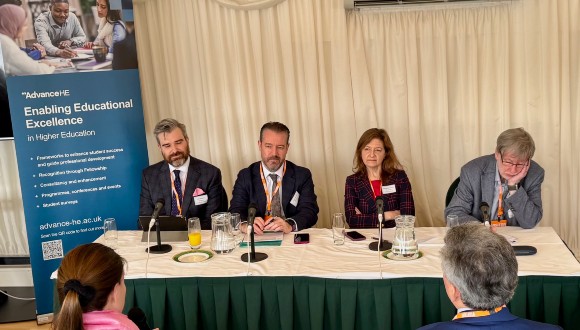
William Syms, Advance HE Head of Communications, reports and reflects on the HEPI/Advance HE Breakfast Seminar, “Is specialisation or collaboration the key to the future of higher education?”
Last week (11 March), I attended a breakfast seminar at the House of Commons, jointly hosted by HEPI and Advance HE and Chaired by our Chief Executive, Alistair Jarvis CBE. The question on the table: ‘Is specialisation or collaboration the key to the future of higher education?’ Three excellent speakers offered different perspectives, and the discussion that followed was rich and genuinely thought-provoking.
Professor Deborah Prentice, Vice-Chancellor of Cambridge, gave a compelling account of what strategic partnership looks like in practice, describing collaborations ranging from a city-to-city partnership with Manchester, to skills development work with Anglia Ruskin, to the long-gestating Oxford-Cambridge growth corridor. Her message was clear: universities can achieve far more together than alone, provided those partnerships are built on genuine complementarity. What struck me was how Cambridge’s approach was resolutely outward-facing; even with considerable resources and global reach, the argument was: we are stronger working together.
Professor David Sweeney brought a harder-edged realism. Drawing on five decades in the sector, he argued that while collaboration and specialisation have always mattered, they are not, on their own, the answer to what is essentially a structural financial problem. His core point was blunt but hard to dispute: the sector has fewer students and roughly the same number of staff – “the numbers do not add up”. He also spoke candidly about the breakdown in relations between universities and government, and the need to build a more constructive dialogue rather than continuing to hit heads against a wall that, as he put it, has not moved. Every institution, he argued, needs to develop its own honest vision for the future, based on its own circumstances, not a blueprint handed down from above.
Alex Proudfoot, Chief Executive of Independent Higher Education, brought the perspective of the independent provider sector, where most institutions are already specialists of one kind or another. He made the case that the real question is not whether to specialise, but what makes each institution special, and what that means for the students it exists to serve. He offered practical examples of providers designing courses around the realities of people’s working lives, reaching students who would never have engaged with a traditional three-year residential degree. His point about flexibility as a form of specialisation was one of the sharpest observations of the morning.
So, specialisation or collaboration? To me, both or a mix and match. But the debate risks understating just how fundamental our challenge actually is.
At a time when the sector’s finances are under severe strain and its value is increasingly questioned and challenged, we have to ask whether we take the current model too much for granted. We may be waiting for government to act rather than acting ourselves. And when we advocate for the sector, we too often do so defensively, in ways that can alienate rather than persuade, that generate heat rather than progress. We ask what universities are for as though it were a rhetorical question. It isn’t. Now may be the moment to answer it honestly, through the lens of what students, employers, communities and the wider public actually need, rather than what institutions have traditionally provided. Failing to do so is not a neutral position. It is a choice, and increasingly, it carries consequences.
Each university is different, and each must find its own path. That path may involve specialisation, collaboration, merger or something harder to name. But it will almost certainly require a willingness to question assumptions that have been treated as givens for decades, and to accept that some necessary changes will be genuinely painful. The sector cannot afford to keep deferring that reckoning.
Asked at the close whether we would see significantly greater collaboration by the end of this parliament, even without regulatory incentives, the panel’s answers were cautious but not without hope. More movement in thinking, yes. Transformative change, less certain. Real collaboration takes time, resource, and the right conditions. But the case for it is strong, and the cost of inertia is becoming harder to ignore.