Falmouth University Senior Lecturer, Lucy Cokes, shares an updated practical seven-tier model to make student industry experience equitable, manageable and scalable.
We are facing an equity crisis in higher education employability. In today’s challenging economic climate, plagued by a persistent cost-of-living crisis, students simply do not have the luxury of undertaking unpaid, extracurricular internships or portfolios, building placements in their spare time.
If professional experience is kept outside the classroom, we inadvertently lock out a massive portion of our student body – particularly those working part-time to survive, or those managing commuting and caring responsibilities.
To make social mobility a reality, we must change our practice. We must design our curricula to bring the real world directly into their timetabled, assessed hours.
The “missing tier” of live briefs
When I first proposed the Hierarchy of Live Briefs in late 2024, my goal was to spark a dialogue about structural equity in curriculum design. I wanted to move the sector away from ad-hoc, selective industry projects.
Two years on, that dialogue has turned into a quiet revolution. At Falmouth University, the hierarchy is printed in A3 and stuck on our staff room wall – a daily visual anchor during our day-to-day work.
However, scholarship is iterative. It was during a collaborative meeting with a fellow academic that a glaring omission in my original framework was pointed out. I had focused heavily on the “gold standard” of paid, produced client work, completely bypassing the very level that busy academics use most regularly: briefs that are unpaid, embedded in assessment, with the ideas pitched to the client. So a new tier has been added to the hierarchy.
In this scenario, a real client provides a brief, and students gain the vital experience of pitching and receiving industry feedback. Because there is no client budget, the work does not go into commercial production.
Omitting this was a mistake as this tier is the absolute mainstay of equitable industry engagement. It preserves fairness, ensuring every single student participates within scheduled hours, while remaining highly achievable for course teams regardless of their discipline’s funding landscape.
Simplifying the choice: a three-question diagnostic
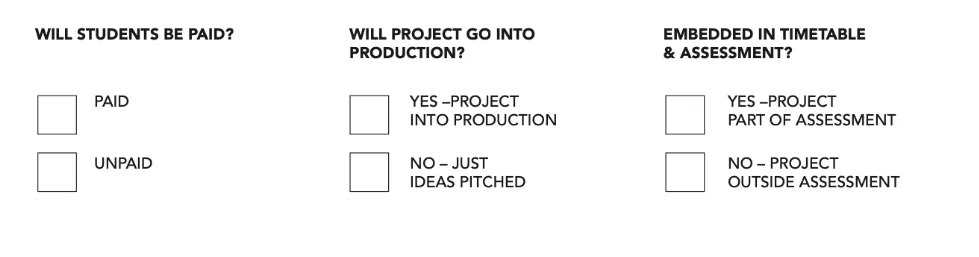
Ultimately, the hierarchy is about giving course leaders simple, manageable options. To strip away the academic jargon, we can map any live brief by answering three binary questions shown in the decision matrix below:
Answering these questions instantly maps a project across our newly expanded 7-tier model:
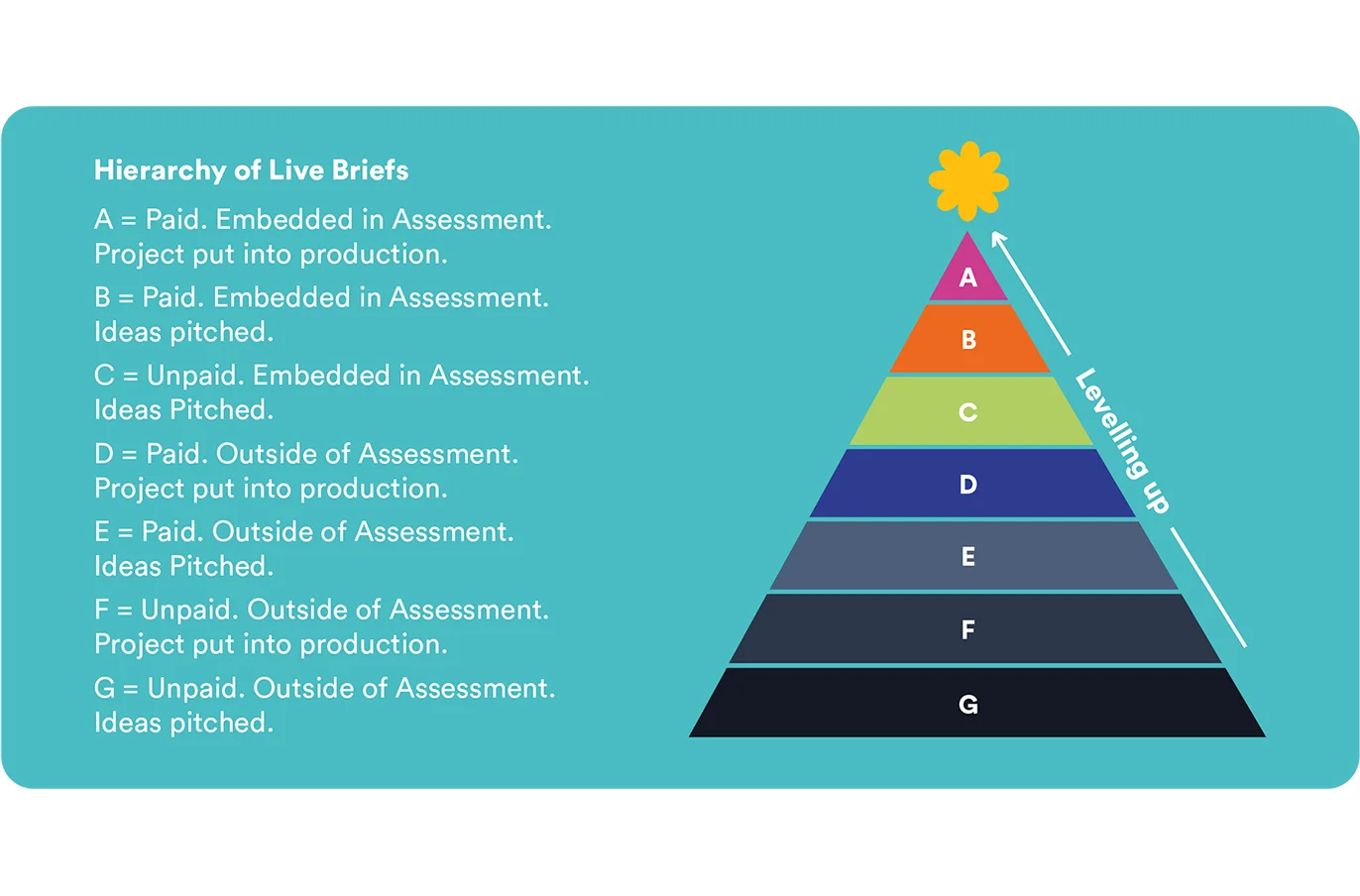
This validates Tier C as an incredibly valuable, highly equitable teaching tool, while giving course teams a realistic roadmap to try and push projects up to a Tier B or A in the future.
Dismantling the operational bottleneck
The biggest barrier to embedding live briefs in higher education is rarely pedagogical, however, it is operational. Creative academics are brilliant educators, but they often freeze when confronted with the legal and administrative hurdles of live projects. How do we handle intellectual property (IP)? How do we write client agreements? How do we map chaotic real-world timelines to rigid 12-week academic blocks? Many staff stop at the first or second hurdle.
Before transitioning to academia, I spent years as a digital agency founder and corporate Chief Operations Officer (COO) managing 80 staff. Systems, contracts and budgets are second nature to me. Having spent years navigating our university’s complex internal bureaucracy to build a repeatable, safe path, I felt a responsibility to share the blueprint I had created.
At our annual staff training event this June, we launched a dedicated Live Brief resource page on our Staff Intranet. It features ready to use templates, including pre-approved client and IP handover agreements and costing estimators. By lowering the administrative barrier to entry, we have seen a dramatic increase in staff confidence. It has turned our staff room poster from an aspirational target into an actionable checklist.
What the data tells us
We must practice what we teach. Over the past academic year, I have gathered quantitative and qualitative data from six different modules at Falmouth University that have actively embedded live briefs.
The early indicators from our employability research are incredibly clear: students working on embedded live briefs report a significantly higher sense of professional agency, improved portfolio confidence and a clearer understanding of how their skills translate to the workplace. Crucially, this boost is felt equally across all demographics, proving that embedding these opportunities directly in modules is a vital tool for social mobility.
Our next step is to take this data-driven blueprint on the road to deliver training workshops at universities across the country. If we want to prepare our young people for the future of work, we have to make our curriculum look more like the world they are entering.
Are you currently using live briefs in your teaching? Where do your modules sit in the seven-tier hierarchy?
Lucy Cokes is a Senior Lecturer in Advertising at Falmouth University, a Senior Fellow of Advance HE and founder of ‘Be Good’, an in-house behaviour change agency. Previously a digital agency founder and corporate COO, she researches the impact of professional agency on student social mobility.