Dr Sarah Yearsley, Senior Lecturer in Education, Childhood and Communities, Liverpool John Moores University shares learning from her research into student continuity.
Supporting student continuation is often associated with what universities do once students have arrived. But what if some of the conditions that enable students to stay are already taking shape before Welcome Week? Drawing together insights from the Advance HE Pre-arrival questionnaire national pilot – Wave One initial results and my doctoral research into student continuation, what we might gain by looking at pre-arrival differently, and by asking not only what challenges students bring with them, but what strengths, relationships and resources they bring too.
When does continuation really begin?
Universities are often prompted to think about continuation when something appears to be going wrong. A student stops attending, misses an assessment, disengages from their learning or starts a conversation about leaving. At this point, institutional processes may trigger interventions designed to re-engage the student and support them to remain.
But are we starting the conversation too late?
Research has shown that continuation is shaped by a complex interaction of academic, social and personal experiences (Tinto, 1993; Thomas, 2012; Kahu and Nelson, 2018). Students also do not arrive at university as blank slates. They bring educational histories, expectations about university life, previous experiences of success and challenge, relationships, responsibilities and existing sources of support.
This is what makes the PAQ particularly interesting. Developed from Michelle Morgan’s work, the PAQ rationale highlights that it is intended to take students on a reflective journey through their previous learning and towards their expectations, concerns and aspirations for higher education. Crucially, it is not simply a data-collection exercise. The information is intended to help institutions listen and respond to incoming students and support their transition into study. Phase one of the national pilot, involving 15 English higher education institutions, has already told us a lot and is providing a much richer picture of the learning histories, expectations, wellbeing concerns and financial pressures students can carry with them into higher education.
For me, this raises a bigger question: what if we started thinking about continuation before there was a continuation problem to solve?
What I learned from students who nearly left
My doctoral research started with a relatively simple question: what might we learn if, instead of asking why students leave university, we ask why they stay?
The students involved in my research had all seriously considered withdrawing from higher education but ultimately continued. What interested me was not only what had brought them to the point of considering withdrawal, but what happened next.
As I brought their experiences together through narrative interviews and Q methodology, it became increasingly clear that there was no single explanation for why a student stayed. Continuation was shaped by combinations of circumstances, relationships, educational experiences, sources of support and students’ own responses to periods of challenge.
This led to me developing my Student Continuity Factors Model.
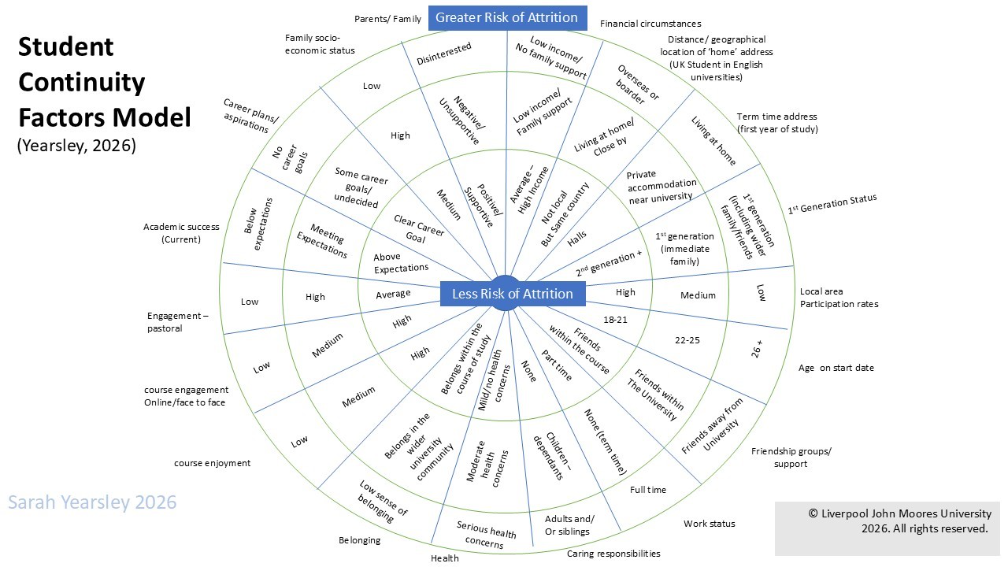
The model brings together influences identified through the research and positions them along a continuum from lower to greater risk of attrition. These range from academic success, expectations and career aspirations to family and financial circumstances, geographical location, first-generation status, friendship groups, employment, caring responsibilities, health, belonging, course enjoyment and academic and pastoral engagement.
What struck me most when developing the model was that no single factor explained continuation. A challenge in one area could exist alongside something protective elsewhere. A difficult personal circumstance might sit alongside strong motivation. Limited connection to university might coexist with powerful family support. Academic uncertainty could be accompanied by a very clear career goal. It was the wider picture that mattered, and many elements of that picture existed before the student arrived at university.
Looking at pre-arrival differently
This is where there is an interesting conversation to be had between the Student Continuity Factors Model and the PAQ.
The PAQ explores previous learning experiences, motivations, expectations, concerns and attitudes towards study. Many influences represented within my model similarly have roots before university: previous academic experiences, career aspirations, family circumstances, caring responsibilities, geographical location and existing support networks.
Others develop later. Students establish new friendships. They encounter their course and lecturers. They begin to judge whether they belong. Academic and pastoral relationships develop. Course enjoyment changes. The different elements start interacting.
Pre-arrival information can therefore give us something of a starting picture before those new university experiences are added.
The first phase of the national PAQ pilot reinforces why that matters. Findings have identified differences in students’ prior learning and expectations, alongside concerns about finances and wellbeing before arrival. They have also challenged assumptions about areas such as students’ previous academic experience, digital access and literacy, and understanding of virtual learning environments and generative AI.
But there is an important question about what we do with this information.
What if we looked for assets as well as risks?
The Student Continuity Factors Model uses the language of greater and lesser risk of attrition. Understanding risk matters. Universities cannot ignore financial pressures, structural inequalities, caring responsibilities or circumstances that make participation in higher education more difficult.
Since completing the research, I have become increasingly interested in another question: What happens when we look at the same information through an asset-based lens?
The students in my research experienced significant challenges. But their stories were not simply stories about what they lacked. They also spoke about motivation, determination, supportive relationships, previous experiences of overcoming difficulty, connections with peers and staff, and developing a sense of purpose and belonging.
The same principle can be applied to pre-arrival information.
A student with caring responsibilities may face genuine constraints on their time, but those responsibilities might also be connected to a powerful motivation for studying. A commuter student may find participation in campus life more difficult, while retaining strong family, community or employment networks. A student who has struggled in previous education may arrive with concerns about academic study but also considerable persistence and knowledge about how they learn.
So perhaps we need to ask two sets of questions.
Not only, ‘what barriers might this student face?‘, but also: ‘what strengths and resources can they draw upon?‘
Not only, ‘what support will they need?‘, but, ‘what support already exists around them, and where might it need strengthening?‘
This does not mean overlooking disadvantage or expecting students to become more ‘resilient’ in the face of structural barriers. Nor does it transfer responsibility for continuation from universities to individual students.
For me, asset-based awareness is about seeing a more complete picture of the student.
The model helps us think about what might matter. An asset-based approach asks us to think carefully about how we use that knowledge.
Turning information into conversations
Of course, knowing more about incoming students only matters if it changes what we do. This is already central to the rationale for the PAQ. It was designed not simply to gather information, but to allow institutions to respond to students’ expectations and concerns and to enable students themselves to reflect on their forthcoming studies.
At programme level, this might mean using cohort insights to rethink induction, transition activities, how unfamiliar academic expectations are introduced, opportunities for students to establish relationships, or how academic and professional support is communicated.
There may also be opportunities for more individualised support where appropriate and where students have consented to their information being used in this way. The national pilot has deliberately explored how institutions can use PAQ data to support students as well as provide guidance to staff.
Personal tutoring is one possible space for these conversations, but it cannot carry responsibility for continuation alone. Curriculum, teaching, relationships, professional services and institutional structures all contribute to the environment students encounter.
Nor should every PAQ response necessarily trigger an intervention. There is a danger that collecting more information simply creates more sophisticated ways of labelling students as ‘at risk’.
The more interesting possibility is to use pre-arrival information to open rather than close conversations: helping students recognise what they already bring, consider what they might need and identify where new relationships and resources can be developed. The goal is not simply to predict who will stay. It is to create conditions that make continuation more possible.
Continuation starts before Welcome Week
There is one final reason why the PAQ is particularly interesting from a research perspective.
My Student Continuity Factors Model emerged from students studying within a particular period of higher education. I do not think it should be regarded as a finished or fixed account of student continuation. It is in fact designed to allow for such changes and adaptation to occur.
Students change. Higher education changes. The conditions surrounding continuation change.
The emerging PAQ evidence is already challenging assumptions about what incoming students know, expect and worry about. That presents an opportunity for a reciprocal relationship between research and practice. Existing research can help us make sense of what we learn from incoming students, but what those students tell us should also challenge, refine and extend our existing models.
In that sense, implementation itself can become a form of educational scholarship, with practice informing research as well as research informing practice.
Ultimately, the value of pre-arrival information lies not simply in how much universities know about their students, but in what they do differently because they know it. The PAQ gives us an opportunity to listen earlier. The Student Continuity Factors Model provides one way of thinking about why some of what we hear might matter for students’ subsequent journeys. An asset-based approach asks us to listen not only for potential difficulties, but also for the experiences, relationships, motivations and resources upon which students can build.
To conclude, if student continuation begins before students arrive, then the work to support continuation should begin there too.