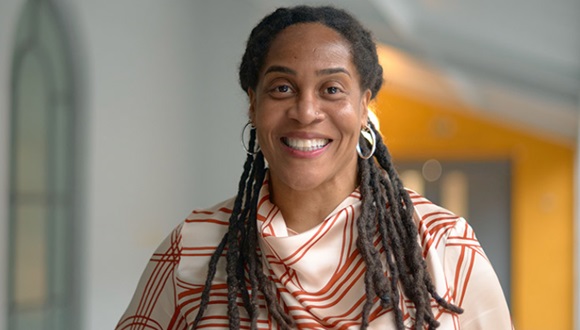
Professor Marcia Wilson discusses her journey to leadership in higher education and her experience of Advance HE’s Top Management Programme (TMP).
Marcia Wilson is one of approximately 6,000 women professors in the UK. She’s also one of just 66 women professors who happen to be Black. She was the first Black woman to participate in Advance HE’s Top Management Programme (TMP) for Higher Education, and the only Black person on her cohort in 2023.
“I was surprised to be the first Black woman on TMP and really quite saddened by it,” she says. “Vice Chancellors have to nominate individuals to be a participant on the programme and given that I was the first Black woman on the programme, it is clear that they are not doing enough to ensure there are enough Black women to be nominated. The lack of Black people on the programme should really be a cause for concern for every single leader, and in particular, VCs.”
Journey to leadership
Marcia’s journey to leadership was via a fairly traditional academic route. Her PhD was at the University of Iowa, graduating in 2000. After that, she worked in the US for a while before moving back to the UK becoming a lecturer then appointed senior lecturer, programme leader, associate Dean, head of school all at the University of East London and then was appointed as the inaugural Dean of EDI at the Open University.
Now Pro Vice-Chancellor Education at Birmingham City University (BCU), Marcia leads on the teaching and learning strategy and is responsible for the Directorates of Education Development Service, Library and Learning Resources, and Careers and Employability.
Before joining BCU, Marcia was the Pro Vice-Chancellor for Student Experience and Institutional Equity at London Metropolitan University where she worked with key stakeholders to enhance the student experience.
“I think I spent too long being a senior lecturer, probably a good seven to eight years, and I’m not sure I used that time as wisely as I could have,” she reflects.
“I enjoy working with students, but I spent a lot of time doing the pastoral stuff.
Whilst other colleagues were writing research papers, getting publications out there or research grants.”
Although Marcia maintains there’s nothing wrong with doing the ‘pastoral stuff’ and that she got a great amount of satisfaction from it because she enjoyed working with her students, she is aware that it’s often women who will find themselves in those more nurturing roles.
“Male academics will be the ones who are getting the grants and writing the research papers and books,” she muses.
“When you look at promotion criteria, it generally lends itself to the grants, books and research papers, so you’ve got think about how you spend your time when you’re at work and be aware of the activities that will help advance your career.”
Senior leadership and race
Although more and more women and a few working-class people are being appointed to senior leadership positions, Marcia is acutely aware that very few Black people are.
“I’m a working-class Black woman, and around the work that I do, race is a primary driver. You don’t know that I’m working class until I speak; I’ve got a Cockney accent and you can see that I’m a woman,” she says. “But when I think about the TMP cohort, half of the people on that programme were women, so I wasn’t in the minority with regards to my sex, but very much with regards to my race.”
Marcia asserts that senior leaders need to have a greater awareness and greater knowledge about anti-racism and how to build anti-racist institutions. She says, “I do not think that we are doing everything that we can possibly do to ensure that Black staff and Black students reach their full potential.
“When we do speak about anti racism, you can see that some people are very, very uncomfortable talking about those issues. But if we don’t talk about these issues in higher education, we won’t be able to address any of the problems that global majority people experience. The disparities among different groups of students and staff will remain because we shy away from those challenging conversations and are more concerned about saying the wrong thing compared to fixing broken systems”.
“It’s really important that we put this back on the agenda and we talk about potential interventions.”
Leadership style
Marcia has had a role in the senior leadership team or executive groups within various universities over the past five and a half years and describes her leadership style as democratic and collaborative.
“I like to influence. I like to work with people. I think in order to make change, you don’t do it by yourself. You have to have a team of competent people that are willing to work with you,” she says.
“I’m fair, but also firm. I don’t shy away from making difficult decisions when they’re needed and I hold myself accountable as well. I take responsibility for the things that I do, regardless of whether it goes well or not so well.
‘Am I doing what I’m supposed to be doing?’
By participating in TMP, Marcia was really keen to hone in on her exact skills. She explains, “It’s a great opportunity to meet people from not only home, but we had a few people from abroad as part of our cohort.
“TMP was a really good opportunity for me to just stop work and think about my career. All too often we don’t do that. You’re just going 100 miles an hour because you’ve got so many things to do.
“Am I in the right institution? Am I doing the things that I’m passionate about? Am I making a difference? Is my work impactful? How do I know that it’s impactful?
“It’s this introspective thing where you start asking yourself, am I doing what I’m supposed to be doing? Am I doing the right things here?
“TMP was great for that. I could just stop and have some really important conversations with myself, colleagues and the facilitators.”
Marcia admits TMP came at an important time for her because it made her realise she needed to focus on the kind of institution that she wanted to work in.
“It was difficult because at the OU I had a really good boss, a boss that I got on well with and a boss that I learned a lot from.
“I had a really supportive senior team around me and and a really good EDI team that I worked closely with.
“But there were certain things missing. I enjoy being on campus and around students. The OU is an online institution that does important work for so many, so it was a difficult decision to leave because there were many things that were absolutely amazing about being at the Open University. But I knew that if I wanted to take that next step that I needed to go somewhere that was a campus based university.
“I am eternally grateful that my boss gave me the opportunity to participate in TMP.”
International trip to Australia
Marcia’s cohort spent time in Perth, Australia, as part of the international module. “It was a real eye opener to see how different institutions operate. That some of the challenges they have over there are the same as what we have over here- the lack of diverse people around that top table,” she reflects.
“One of the things that I was looking at was the EDI aspect. Where are the Aboriginal indigenous people around your senior team? I thought it was really interesting that every time we visited an institution, there was a statement that was said at the very beginning of any presentation paying homage to the fact that we are visitors here and we do not own this land. But the people that do own the land were not in the room. That was the same in all but one of the institutions that we went to, so it’s quite the contradiction. It’s not enough to say that statement and then have nothing or very little in place that will change the status quo because then your words become hollow and meaningless.”
‘I have a clearer vision of what I want to do and where I want to go’
There are things that Marcia now does differently as a result of what she learned on TMP.
She says, “I think I carry myself differently and I’m more confident in the things that I’m doing at work. I have a clearer vision of what I want to do and where I want to go.
“I am choosier about my work – there are things that I say yes to; things that I say no to. I’m a lot more focused on my career and the tasks that I do.
“I also think very carefully about how I work and interact with people because it can have a major impact on the things they do and when they do it. I’ve become quite boundaried; I used to send emails to just try and clear them off my desk. But now it’s very rare that you’ll get an email from me past 6pm. I might type it up, but you won’t get it because I know if I send an email at 8pm, I’m gonna get a reply simply because of the position that I hold. I don’t want people to be working at 8 o’clock in the evening unless it’s an absolute emergency.”
Advice for your younger self
When asked what advice she would give her younger self, Marcia says, “Just go for it, think about what you want, think about your goals, begin with the end in mind and go for it.”
She used to worry about certain things and wasn’t as confident as she is now. But confidence, she knows, comes over the years of doing the job.
She says, “Grab opportunities with both hands, don’t worry about what other people think and whether you can do it. If you can’t do it, learn how to do it.
“Capitalise on opportunities. When I was at the University of East London (UEL) we had the 2012 Olympic Games and Paralympic Games come to Stratford. It was on our doorstep and my background is in sports psychology. I remember badgering the Dean and anyone else who would who would listen, saying that we really need to capitalise on the fact that in a few years from now we’re going to have the world looking at Stratford and we’ll miss a trick if we don’t do something.
“At that point, we didn’t have a separate sport science department. It was because of the 2012 Games that we established our own sports science department and I was the first Head of Sports Science at UEL.
“From that you create partnerships with some very different organisations that are linked to the Olympics and Paralympics and you make sure that you capitalise on what that mega event has to offer.”
Another area that Marcia was able to capitalise on was when she was Head of School at UEL and she had access to all the reports around the disparities for different groups of students when doing race equality work or Athena Swan.
She says, “It’s really important that we don’t just note disparities and move on. We need to intervene with an action plan to address it and that’s how the Office for Institutional Equity was established. I put together a business plan to show that we are serious about closing gaps and addressing the disparities, especially in an institution like the University of East London.
“It can make a real difference to so many of our students and staff – from an ethical, moral and a business sense”.
“That’s how the Office was born and now UEL are doing fabulous work in that space and have a Silver Race Equality Charter award.”
‘Find your people’
Marcia’s advice to young Black academics from working class backgrounds is to “find the people who are your allies”. She says it’s important because you can’t do this work on your own.
“You have to find your network of people who are your allies and who will champion you. People who do not make you feel like an outsider.
“Don’t change your accent or anything like that. It’s important that people see you as you are. Being Black, being working class, you may well be the first and only person in the department who looks like you and who sound sounds like you. But somewhere in that institution or across the sector, or even outside of the sector, there will be people who will champion you and who will support you.
“We’ve got loads of working-class, global majority students. They need to see and hear us being proud of who we are and they need to see us succeed as our authentic self – not a poor imitation of someone else”.