A team of educators is trying to help define, and understand the associated challenges faced by, Early Career Educators in allied health and/or biological sciences in UK higher education.
The Early Career Researcher (ECR) is a well-defined across UK higher education (HE). It is a well-supported group with established definitions, support structures, funding opportunities and career development pathways.
But what is an Early Career Educator (ECE)?
We are keen to create a clearer definition of what it means to be an ECE in UK HE, to better understand the challenges faced in this role and make informed suggestions to better support these individuals.
Why does this matter?
The Higher Education Statistics Agency (HESA) suggested there were 85,620 teaching-focused academics across UK HE institutions, increasing from 66,355 over the past five years. This represents an increase of 29%.
In contrast, the number of staff on research-only contracts decreased by 2% over the same period. This expansion of teaching-focused roles is particularly striking given the wider financial instability facing the UK higher education sector, with recent analyses highlighting increasing institutional deficits, redundancies and course closures. As more academics are employed on education-focused roles, it is vitally important those new to the role are supported to ensure better outcomes for the students as well as their own career progression.
In the UK, academic positions in the allied health and/or biological courses have traditionally combined both teaching and research responsibilities. Only in recent years have teaching and scholarship-specific roles emerged more prominently, and individuals new in these positions are often referred to as “early career educators”.
Despite being indispensable to the sector, the term “early career educator” remains insufficiently defined in the context of UK higher education. Moreover, the specific challenges faced by this group have not been comprehensively examined, underscoring the need for further investigation.
Why do we care about this?
Developing a contextualised definition of an early career educator could help universities design targeted training, clarify eligibility for funding, and support more structured career progression for those pursuing education-focused academic pathways. This is becoming increasingly important in a sector where tuition fee income forms a major component of institutional revenue, and where incoming government policy increasingly ties funding to educational quality and student outcomes.
Against this backdrop, investment in the professional development of educationalists has become a strategic necessity. Clearly defining the stages of an educator’s career, beginning with the early career phase, has therefore moved beyond an area of conceptual interest to becoming a strategic priority for the sector.
While the majority of our team consider ourselves to be ECEs, we recognise that a definition is not straightforward.
There seems to be a classically known definition of ECRs which is typically five years from your PhD or until independence, however that definition simply does not apply to education-focused careers.
For example:
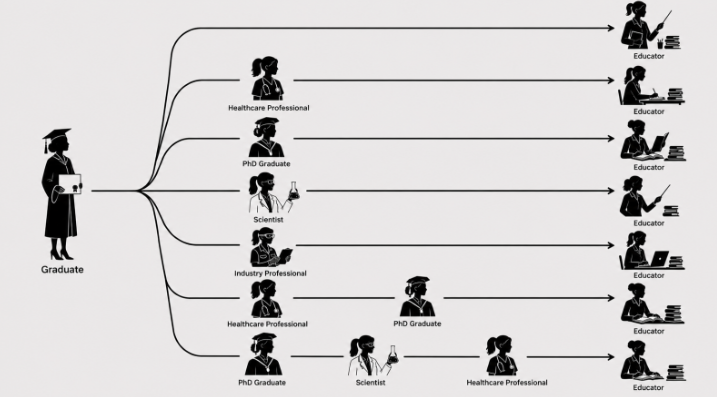
There are many fields present in HE that appoint high-quality educators without a PhD, how do we capture them? What about researchers 20 years post-PhD that move to a teaching contract for the first time? What about a colleague who moves from industry to academia?
Once in post, experiences also differ, yet some problems appear to be ubiquitous. Many colleagues report a lack of mentorship and networks to connect with, and learn from, other ECEs. Further, this lack of awareness and support extends further into few/no funding opportunities or training resources targeted specifically at ECEs.
In some STEM-aligned disciplines there can be a lingering stigma around education-focused roles. Colleagues may encounter assumptions that they only choose an education track because they are ‘only in it for a more stable contract’ or are ‘failed researchers’. However, preliminary insights from the study highlight genuine motivations and passion for improving the quality of education, and the opportunities available to their students.
Rather than just talk amongst ourselves as a research team, we are keen to come up with an evidence-based definition of the ECE encompassing the experiences and challenges faced by other educators in the UK. Only in this way can we then suggest meaningful strategies to better support and develop ECEs.
What are we trying to do about this?
We are therefore surveying educators across the UK to help define, and understand the associated challenges faced by, Early Career Educators. Or, to state it more explicitly we are trying to answer the following questions:
- how do you define the Early Career Educator in the context of UK higher education?
- What challenges are faced by Early Career Educators?
- How can Early Career Educators be better supported by higher education institutes?
Help shape the future of ECEs
Interested in helping shape the experiences of future Early Career Educators and/or sharing your own experiences?
For this project, we are focusing on educators who hold Education (or Teaching) and Scholarship contract and teach on courses related to allied health and/or biological sciences in the UK, however, we hope that the findings will be applicable to all Early Career Educators.
Importantly, you do not have to identify as an ECE to participate in the study. We were all ECEs at some point, and keen to learn from experiences of those in the past and how challenges may have changed over time.
Take the survey
If you have any further questions about this research, please contact the monitored project inbox at ECEProject@bsms.ac.uk, or the project lead Dr Oli Steele (o.steele@bsms.ac.uk).
Oli Steele is an Associate Professor of Physiology at Brighton and Sussex Medical School. In addition to a wide and varied physiology teaching load to medical students, Oli is also the Academic Lead for Widening Participation.
Catriona Cunningham is a teaching-focused Lecturer in Physiology and Pharmacology at the University of Aberdeen. She is Lead for Assessment (Science Programmes) in her school.
Our pedagogic interests neatly align and include active learning approaches, student-led content creation and making programming teaching more engaging.